What This Article Covers
Learn the NSW rules for overtaking cyclists, including minimum passing distances, common mistakes, when to wait, and how to pass safely.
Give Cyclists More Than Just a Quick Pass
You’re driving along a busy road and suddenly find yourself behind a cyclist. There’s traffic coming the other way, cars are building up behind you, and you’re wondering whether you have enough room to get past. It can be tempting to squeeze through and get it over with, but overtaking a cyclist safely is about more than simply getting around them. If you’re learning with a Sydney Driving School, you’ll need to understand how much space to leave, when it’s safe to pass and when it’s better to wait. In NSW, there are specific minimum passing distance rules for cyclists. Knowing them can help you make better decisions and give everyone more room to stay safe.
How Much Space Do You Need to Give a Cyclist?
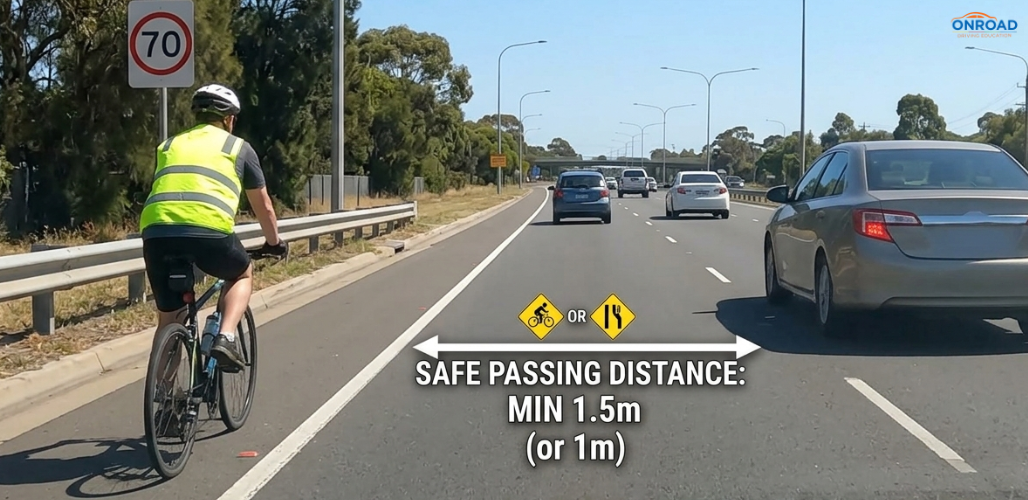
When overtaking a cyclist in NSW, you must leave at least 1 metre between your vehicle and the cyclist when the speed limit is 60 km/h or less, and 1.5 metres when the speed limit is more than 60 km/h. But what’s more important is that this requirement is based on the speed limit applying to the road, not simply how fast you happen to be travelling. That might sound straightforward, but judging a metre or more of space from the driver's seat isn't always easy. This is one reason it's better to slow down and create more room rather than trying to pass as quickly as possible. If you're unsure whether you're leaving enough space, our guide on how much room you should give cyclists can help you understand some of the common mistakes drivers make.
Why Does Passing Distance Matter?
Cyclists don't have the same protection as people inside a car. They can also need to move further away from the kerb because of rough surfaces, debris, parked cars, or other hazards. Cyclists may sometimes need to use more of the lane when dealing with these situations. Giving a cyclist enough space gives them more room to respond if something changes around them. It also gives you more time and space to complete the manoeuvre without putting them too close to your vehicle.
What Should You Do Before Overtaking a Cyclist?
Before you move around a cyclist, take a moment to look at the whole road rather than focusing only on the bike in front of you. Check your mirrors and blind spots, look for approaching vehicles, and consider whether another road user could enter your path. You also need enough room to pass while maintaining the required distance and enough space to return to your lane safely. This is where good hazard perception becomes important. Developing hazard perception skills can help you recognise potential problems before you commit to an overtake. If the situation doesn't look right, don't force it. A few extra seconds behind a cyclist is better than making a risky move.
What If There Isn't Enough Room to Pass?
Sometimes the safest option is simply to wait. If you're on a narrow road, there's oncoming traffic, or you can't maintain the required passing distance, slow down and stay behind the cyclist until you have a safe opportunity. NSW rules allow drivers to cross or straddle certain single or double dividing lines when overtaking a bicycle, provided they have a clear view of approaching traffic and it is safe to do so. Don't let a queue of cars behind you pressure you into passing before you're ready. Maintaining a safe following distance while you wait gives you more time to respond and keeps the situation under control.
Common Mistakes Drivers Make Around Cyclists
Even experienced drivers can make poor decisions when they're in a hurry. Some common mistakes include:
-
Passing too closely
-
Failing to check blind spots
-
Moving around a cyclist without checking approaching traffic
-
Rushing because another driver is waiting behind
-
Moving back into the lane too soon
-
Assuming the cyclist will stay close to the kerb
A cyclist may need to move further into the lane to avoid an obstacle, so give them room and be prepared for their position to change.
Take Extra Care Near Intersections
Intersections and roundabouts require extra attention because cyclists can be difficult to spot among other vehicles. Before turning, check your mirrors and blind spots and look carefully for cyclists travelling alongside or approaching from another direction. Taking a few extra seconds to scan properly can help you spot a cyclist before you commit to a turn or manoeuvre.
Build Better Overtaking Habits
Knowing the rules is important, but learning when to wait, how to judge a gap and where to position your vehicle takes practice. A driving lessons can give you the opportunity to work on these decisions with an instructor in real traffic. The same practical awareness can also be reinforced through a Safer Drivers Course, where developing safer decision-making and hazard awareness is part of becoming a more responsible road user.
Give Everyone More Room
Overtaking a cyclist safely doesn't need to be complicated. Check the road, slow down when necessary, leave the required space, and don't feel pressured to pass until you know it's safe.
A little patience can make a big difference. If you want to improve your overtaking, positioning and hazard-awareness skills, book a driving lesson with Onroad Driving School. Our instructors can help you practise real-world situations and build the confidence to make safer decisions on the road.
Frequently Asked Questions
Q1. How much space must you leave when overtaking a cyclist in NSW?
A: You must leave at least 1 metre when the speed limit is 60 km/h or less, or 1.5 metres when the speed limit is more than 60 km/h.
Q2. Can you cross a double line to overtake a cyclist in NSW?
A: Yes. You can cross or straddle single or double dividing lines to pass a cyclist if you have a clear view of approaching traffic and it is safe to do so.
Q3. What should you do if there isn't enough room to pass a cyclist?
A: Slow down and wait until you have enough space to pass safely while maintaining the required distance.
Q4. Do you have to slow down when passing a cyclist?
A: You should slow down when necessary to safely overtake and maintain the required passing distance. You must also stay within the speed limit.
Q5. Should you check your blind spot before overtaking a cyclist?
A: Yes. Check your mirrors and blind spots before moving around a cyclist, and make sure the road ahead is clear.
Q6. Can cyclists ride in the middle of a lane in NSW?
A: Yes. Cyclists can use the middle of a lane when necessary, including when avoiding hazards such as rough road edges or debris. Drivers should slow down and give them enough room.