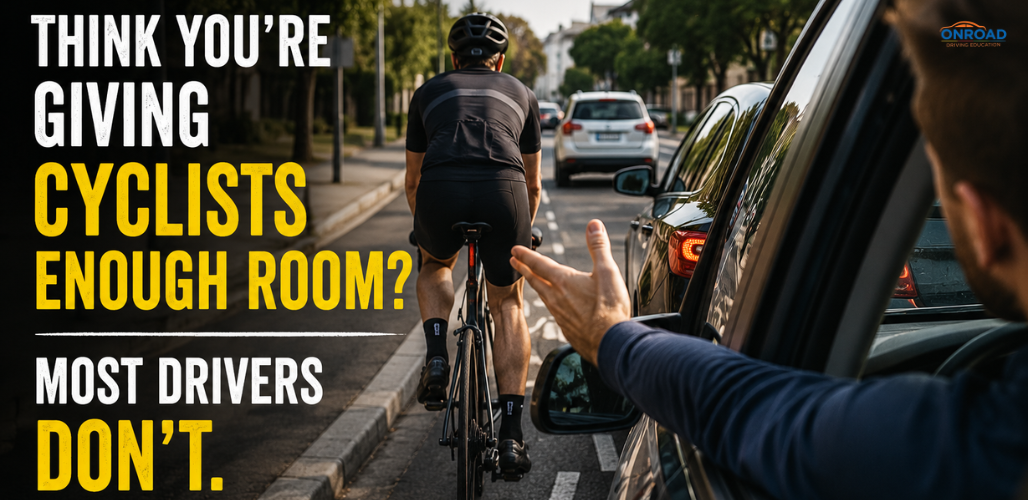
What This Article Covers
This article explores the hows and whys of the minimum passing distance rule for overtaking cyclists when driving on a road with a speed limit of 60 km/h. It discusses why just 1 metre and also offers some key points to remember when attempting to pass a cyclist on the road.
The Situation Every Learner Faces
When you’re driving on a road with a speed limit of 60km/h and you notice a cyclist riding in your lane, your first instinct is usually to overtake them quickly and keep moving with the traffic. But when you’re passing the cyclist, do you pay much attention to keeping a minimum passing distance in your rush? Leaving enough distance when overtaking a cyclist matters more than you’d think. Beyond breaking the law and increasing the risk of accidents, it could also lead to fines and loss of demerit points.
Recent data from Transport for NSW indicates that around 85% of cyclist casualties in NSW involve another vehicle. This stark statistic is also the main reason for implementing the minimum passing distance rule for cyclists. Whether you’re a seasoned driver or a newbie taking driving lessons with a driving school, following the minimum distance rule is a must for all. So, knowing what the rule is, where it is applied, how it works, and why it matters can help you stay safe and compliant. Here's a quick rundown of exactly what the rule says, why it's set at that distance, and how to apply it confidently on the road.
The Minimum Passing Distance Rule: At Least 1 Metre of Space
In NSW, the minimum passing distance rule states that when you’re driving in a zone with a speed limit of 60 km/h and passing a cyclist, you must leave a space of a minimum of 1 metre between your vehicle and the cyclist. This rule is designed to protect one of the most vulnerable road users, the cyclists, who are likely to suffer more in case of a collision. And if the speed limit is above 60 km/h, the minimum required space becomes 1.5 metres. And it makes you wonder why just 1 metre, not more or less?
Why 1 Metre, Specifically?
It’s not a randomly chosen number, as most people would assume. The true reason for choosing the distance of 1 metre specifically lies in science. A cyclist doesn't travel in a perfectly straight line the way a car does. A pothole, loose gravel, a gust of wind, or a car door swinging open ahead of them can all cause them to swerve suddenly. A 1-metre buffer is approximately sufficient to absorb such unexpected movement without causing a collision. Plus, it also accounts for the fact that a rider's effective width is more than just their bike. The space they occupy on the road also includes the handlebars, their outstretched arms signalling a turn, or even the slight wobble they have when riding at low speed. So, if you’re judging the gap from the edge of their tyre alone, you’ll almost always be closer than you think. That’s why the distance of 1 metre is considered a safe minimum passing distance.
So, how to judge a full metre distance accurately while driving? A simple trick many driving school instructors teach during their driving lessons is picturing the width of an open car door that's roughly the space you're aiming to leave.
What If You Can't Fit a Full Metre?
There are always situations where you might find that leaving so much space is not really possible. And it’s also a question most learners end up asking their driving school instructors the most. When drivers think the lane is too narrow to leave a full 1 metre space, they either squeeze past anyway or sit indefinitely behind the cyclist unsure what to do. In such cases, here’s what you can do. You can cross centre lines, including double lines, to give the cyclist the necessary passing distance. However, this is allowed only if there’s no oncoming traffic on the road and it’s safe to do so. Giving the safe gap to the cyclist is always more of a priority than staying strictly within your lane markings, provided you have a clear view ahead and no traffic is approaching.
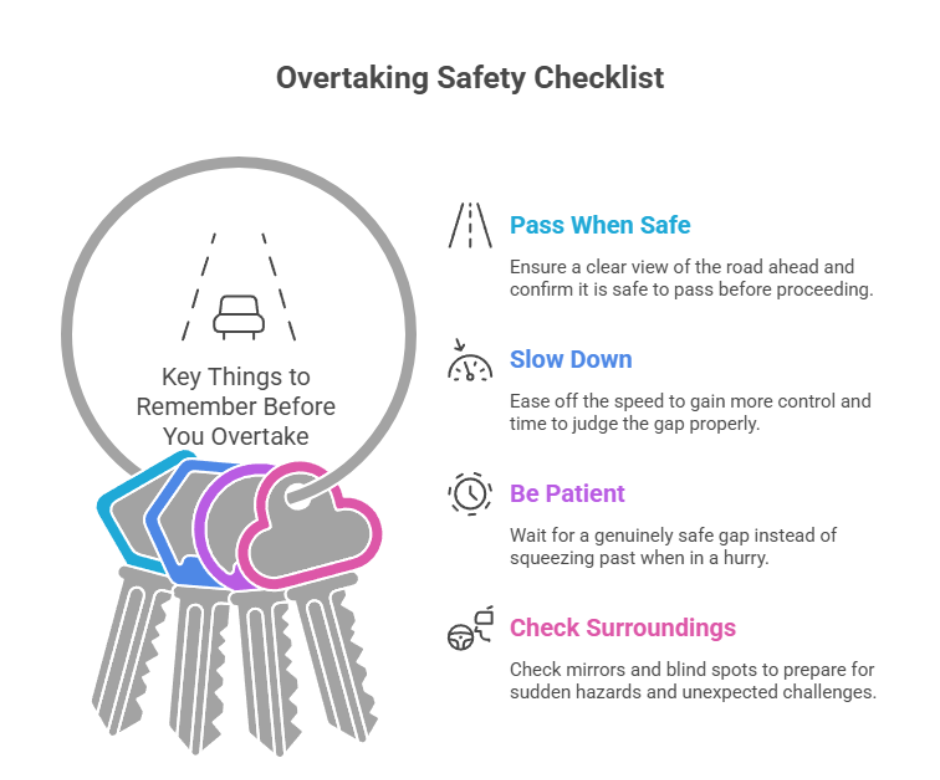
Key Things to Remember Before You Overtake
Pass Only When It's Safe:
Make sure you have a clear view of the road ahead, and it’s safe to pass. If you can't see far enough ahead to know the road is clear of oncoming traffic, wait. Passing blind, even if it is to give the required 1 metre to a cyclist, isn't worth the risk.
Slow Down If You Need To Create Enough Space:
You don't have to overtake at the same speed you were travelling. Easing off gives you more control and more time to judge the gap properly.
Be Patient:
It can be tempting to squeeze past when you're in a hurry, but waiting a few extra seconds for a genuinely safe gap is always the better call. Most learner drivers find that patience becomes second nature the more time they spend behind the wheel.
Check Your Mirrors And Blind Spots:
Before you move out, check your mirrors and blind spots. Just like when changing lanes, overtaking a cyclist can also come with unexpected and sudden challenges. So, checking what's happening around your entire vehicle, not just what's ahead, can help you prepare for sudden hazards and know whether you need to wait or slow down.
Before You Overtake, Run Through This
Now you know what to do when you need to overtake a cyclist and why. So, the next time you spot a cyclist ahead, here’s a list of quick check questions to ask yourself:
-
Is the road clear ahead, with no oncoming traffic?
-
Am I slowing down to give myself more control?
-
Do I actually have 1 metre and not just "close enough" distance?
-
Have I checked my mirrors and blind spots before moving out?
If the answer to any of these is no, wait. Don’t rush and end up risking your and other road users’ lives.
Remember: One Metre, Every Time
Reading about the rule is one thing, and actually judging the distance and timing for overtaking a cyclist is another entirely. It requires you to stay alert and aware not only of the traffic lights and road signs, but also of the road ahead and your surroundings. Joining a Safer Drivers Course or learning with a reputed Sydney driving school can help you build this situational awareness and improve your hazard perception through repetition and real-world practice.
At Onroad Driving School, we understand the importance of preparing learners for real-world scenarios. We have professionally trained experts who do much more than simply teach the rules. They show you how to apply them in real situations, like cyclist encounters. Join our many driving courses today and learn the best ways to become a safe and responsible driver.
Frequently Asked Questions
Q1: What if I don't leave enough space when passing a cyclist?
A: If you don't leave the required minimum passing distance, you could receive a fine and lose demerit points under NSW road rules. This isn't just a recommendation. It's a legal requirement designed to protect cyclists and other road users.
Q2: Can I cross double lines to overtake a cyclist in NSW?
A: Yes, you can. If there's not enough room to pass a cyclist safely within your lane, you're allowed to cross centre lines, including double unbroken lines, provided it's safe to do so, and you have a clear view of oncoming traffic. This exception exists to help drivers maintain the required passing distance.
Q3: How much space do I need to leave when passing a cyclist?
A: It depends on the speed limit. If the road is 60 km/h or below, you must leave at least 1 metre. On roads with speed limits above 60 km/h, you need to leave at least 1.5 metres when passing a cyclist.
Q4: How is the 1 metre passing distance measured?
A: The distance is measured from the widest part of your vehicle, such as the side mirror, to the widest part of the cyclist or their bike, like the handlebars or the rider's shoulders. This is why it often feels closer than drivers realise, so it's always better to leave extra space whenever possible.