What This Article Covers
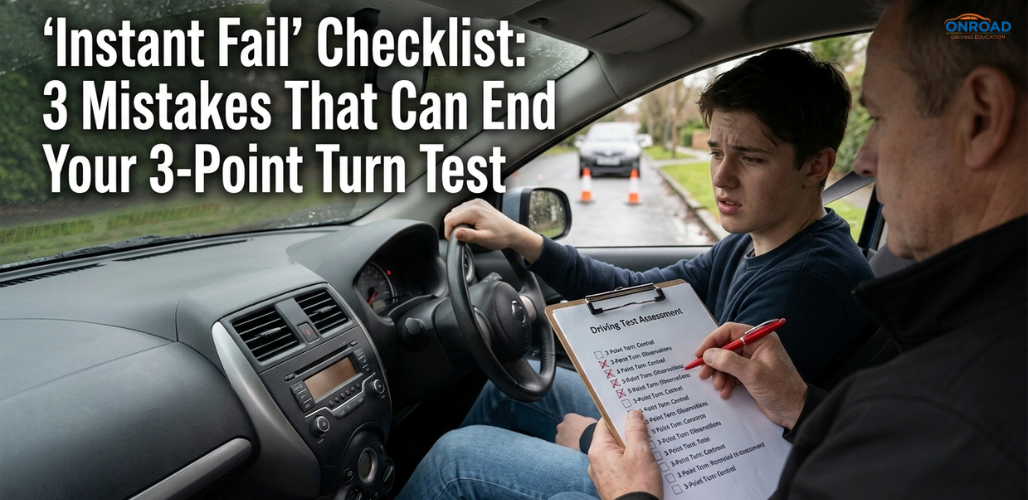
Feeling nervous about the 3-point turn? This guide explains the three mistakes that can lead to an instant fail in the NSW driving test, what examiners are really looking for, and how you can approach the manoeuvre with greater confidence.
Why the 3-Point Turn Feels So Intimidating
Many people assume passing the driving test is easy as long as you’re a decent driver. And while they’re not completely wrong, they do ignore one key fact about human behaviour. Pressure situations that come with expectations often make us nervous and prone to making mistakes. And few parts of the NSW driving test make learner drivers as nervous as the 3-point turn. Not because the technique is particularly difficult, but because you believe even a single mistake can cost you the test. That pressure often leads you to rush through your decisions, miss key observations, and make unnecessary errors.
The truth is that a 3-point turn isn't a test of how quickly you can turn the car around. Examiners are watching far more than your steering. They’re trying to see how safely and confidently you can control your vehicle in a confined space. Understanding what they're assessing can make the turn feel much less intimidating.
What Examiners Are Really Looking For During a 3-Point Turn
Most new learners think a 3-point turn is mainly about steering the car. However, they don’t realise that it's only one part of the picture. Your eyes play a bigger role in 3-point turns than you realise. Looking well ahead, checking mirrors, scanning for hazards, and performing shoulder checks are not perfunctory rules. These actions help you judge distance and control the vehicle more accurately. During a driving test, if the examiner asks you to do a 3-point turn, it’s not just about your steering control. It is also to assess how well you:
-
Observe your surroundings before and during the turn.
-
Keep the vehicle under smooth, controlled movement.
-
Make safe decisions if traffic or pedestrians appear.
-
Position the vehicle accurately without creating risk.
Most Sydney driving school often emphasise proper observation because your eyes matter more than your steering wheel in a 3-point turn on driving test day. If you master this skill, you’re more likely to make a smoother and easier turn even in challenging situations.
Instant Fail Mistake #1: Failing to Observe Properly
As we discussed earlier, observation is a key skill for a driver, especially in tricky manoeuvres like a 3-point turn. But if you think checking your mirrors once before starting is enough, you’re mistaken. You must continue observing your surroundings throughout the entire turn. If another road user enters the area, you may need to stop safely and give way before continuing. And for that, you must be aware of your surroundings at all times. Before you move in any direction, check your mirrors, look for approaching vehicles, cyclists and pedestrians, and do the necessary head checks. It’s what examiners actually want you to do to ensure you’ll drive safely. A perfect turn means very little if you haven't demonstrated safe observation along the way.
Instant Fail Mistake #2: Losing Control of the Vehicle
A 3-point turn isn’t something you can rush through. It is usually performed at low speed, which gives you enough time to think, plan, and make smooth adjustments. But if you’re rushing, you’re more at risk of losing control of your vehicle. So, if you’re trying to mount the kerb, rolling too quickly, steering abruptly, or allowing the vehicle to drift out of position, that indicates a lack of control. Even if you eventually complete the turn, the examiner needs to see that you can place the vehicle precisely where you intend. So, instead of rushing to complete the turn, you should focus on making a calm, controlled, and accurate one.
Instant Fail Mistake #3: Creating a Dangerous Situation
This is the mistake examiners take most seriously. If your actions force another road user to brake, swerve, or change course to avoid you, it means you've created an unsafe situation. The same applies if you pull out when it isn't safe or fail to give way during the turn. It's easy to become so focused on completing the 3-point turn that you forget the road around you is still active. This single-minded focus on the turn alone can lead you to make mistakes. In such situations, the safest response is to pause and stay calm. If you wait a few extra seconds for a vehicle or pedestrian to pass, it won’t cost you the test. Instead, it shows you have good judgement. Examiners would much rather see patience than unnecessary risk.
What If You Make a Small Mistake?
Most Sydney driving schools teach you to focus on your strengths and build safer habits to pass the test. But they don’t talk about how many mistakes are allowed in a driving test in NSW and how to avoid them. However, even if you do commit a mistake, it doesn't automatically mean you've failed your driving test. Serious safety errors can result in an instant fail, but not every mistake carries the same consequence. Many learners become flustered after a minor error, assume the worst, and then make additional mistakes because they've lost confidence. The important thing is to stay calm and keep driving safely. If you need to make a small correction to your steering or reposition the vehicle while maintaining full control, don't panic. What matters most is how safely you manage the situation.
Practise the Right Habits, Not Just the Turn
A perfect 3-point turn isn’t about memorising a sequence of steering movements. It is about developing the right habits. Every time you practise a 3-point turn, you should build a habit of observing your surroundings before every movement, keeping the car moving slowly and smoothly, and staying aware of everyone around you. Don't rush to complete the turn just because you're nervous. Instead, practice so much that these habits become automatic. With enough practice, performing a 3-point turn will certainly feel far less stressful on test day.
Build Confidence Before Your Driving Test
Passing the 3-point turn isn't about performing a perfect routine. It's about showing that you can make safe decisions, stay aware of your surroundings, and control your vehicle with confidence. If you want to master the 3-point turn, get proper driving lessons from a professional and experienced Sydney driving school instructor. They’ll guide you on your strengths and weaknesses, and the right points to focus on to become a better driver and clear the driving test.
At Onroad Driving School, our experienced instructors help learners practise manoeuvres under real-world road conditions while building the observation and decision-making skills that examiners look for. With the right guidance and consistent practice, you'll feel more prepared every time you get behind the wheel.
Frequently Asked Questions
1. Is hitting the kerb an instant fail during a 3-point turn in NSW?
A. Mounting the kerb during a driving test may be assessed as a serious safety error because it shows a loss of vehicle control. The outcome depends on the circumstances and the examiner's assessment, but it's something every learner should aim to avoid.
2. Can I stop during a 3-point turn in the driving test?
A. Yes. If you need to stop safely to check for traffic or allow another road user to pass, that's often the safest decision. Staying in control and giving way when required is more important than completing the manoeuvre quickly.
3. What if another car approaches while I'm doing a 3-point turn?
A. You should assess the situation and give way if necessary. Being patient and allowing other road users to pass demonstrates good judgement and safe decision-making.
4. Can I correct my steering during the manoeuvre?
A. Small corrections are normal if they're made smoothly and safely. Don't panic if the car isn't perfectly positioned. Staying calm and maintaining control is far better than making sudden or rushed movements.
5. How can I improve my 3-point turn before the NSW driving test?
A. Regular practice with a qualified driving instructor is one of the best ways to improve. Practising in quiet streets while focusing on observation, speed control, and smooth steering will help you build confidence and develop safe driving habits.