What This Article Covers
In this article, we discuss what basic things you should check before your driving test, what documents and vehicle requirements you need, and the ultimate driving test day checklist for each state.
Your Driving Test Starts Before You Turn the Key
A driving test is an important milestone in our lives, so feeling excited, overwhelmed, and nervous on the test day is quite natural and expected. Whether you’re practising with family or learning from a reputed Sydney driving school, passing the driving test is the only way to determine if you’re ready to face the road yet.
Most learners spend weeks practising manoeuvres, improving their observation skills, and becoming more road-ready, only to end up floundering before the examiner. Small, inconsequential mistakes, such as a missing document, faulty brake light, incomplete logbook, or overlooked state requirement, can instantly ruin your test day. That’s why being mentally and physically prepared for the test matters just as much as driving ability. Having a proper checklist before test day can help you feel calmer, more organised, and more confident behind the wheel. In this blog, we bring you a practical driving test day checklist for every Australian state and territory.
The Night Before Your Driving Test
The night before the test day is often filled with stress, nerves, and constant revisions. And being prepared the night before is actually a good thing. It can help you feel prepared and confident. So, before you let sleep take over, make sure you:
-
Confirm your test location and appointment time.
-
Keep your learner's licence and required documents ready.
-
Check that your logbook submission has been completed if required.
-
Make sure you get enough sleep.
-
Avoid over-practising or cramming rules at the last minute.
-
Choose comfortable clothing and proper driving footwear.
While being prepared is important, chasing perfection and trying to keep everything ready beforehand will only get you stressed. Remember, being rested and sitting the test with a calm mind matters more.
Universal Driving Test Day Checklist
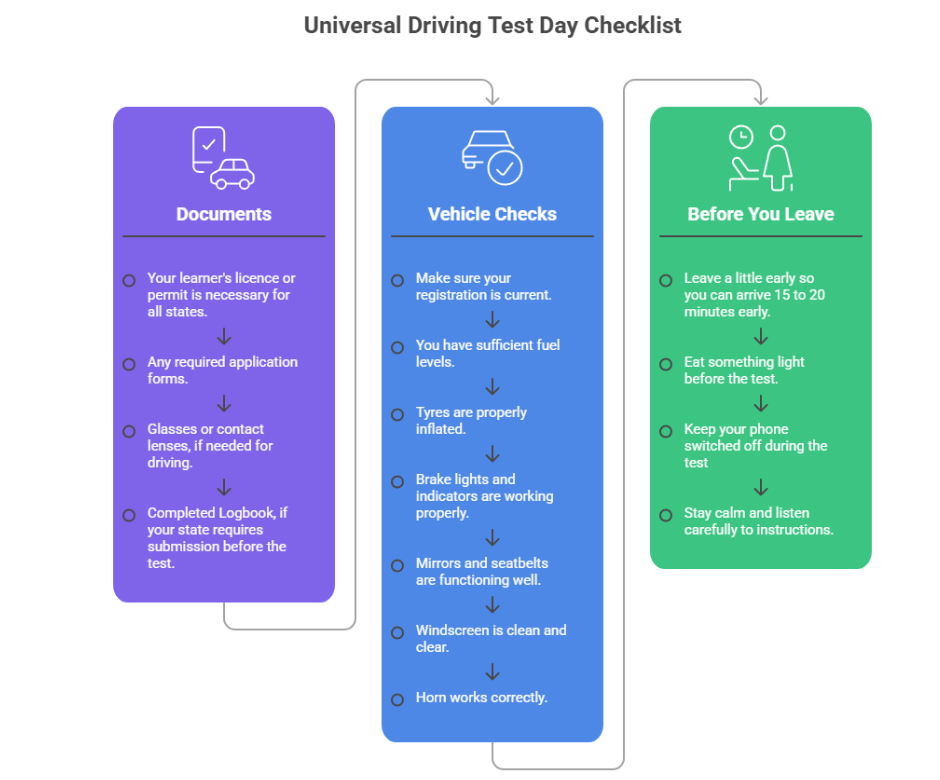
So, yes, it’s possible that you’re not very nervous, but still being prepared is always better. Here’s the list of common things that all learner drivers across Australia should check before leaving home:
Documents
-
Your learner's licence or permit is necessary for all states.
-
Any required application forms.
-
Glasses or contact lenses, if needed for driving.
-
Completed Logbook, if your state requires submission before the test.
Vehicle Checks
-
Make sure your registration is current.
-
You have sufficient fuel levels.
-
Tyres are properly inflated.
-
Brake lights and indicators are working properly.
-
Mirrors and seatbelts are functioning well.
-
Windscreen is clean and clear.
-
Horn works correctly.
Before You Leave
-
Leave a little early so you can arrive 15 to 20 minutes early.
-
Eat something light before the test.
-
Keep your phone switched off during the test
-
Stay calm and listen carefully to instructions.
Whether you learn with family or attend a reputed Sydney driving school, this checklist can help you beat the nerves and stay confident during the test.
Quick State-by-State Driving Test Comparison
|
State / Territory
|
Logbook Hours
|
Night Hours
|
Hazard Perception Test
|
Key Requirement
|
|
New South Wales
|
120
|
20
|
Yes
|
You need to submit a digital logbook 48 hours before the test.
|
|
Victoria
|
120
|
20
|
Yes
|
Centre handbrake is necessary.
|
|
Queensland
|
100
|
10
|
Yes
|
You must submit the logbook 12 business days before the test.
|
|
Western Australia
|
50
|
5
|
Yes
|
You must remove the L plates before the test.
|
|
South Australia
|
75
|
15
|
Depends on the route.
|
Your vehicle must pass the roadworthiness check.
|
|
Australian Capital Territory
|
100
|
Not specified
|
Yes
|
You must have a Pre-learner course certificate.
|
|
Tasmania
|
80
|
15
|
Yes
|
You must complete your HPT through Plates Plus.
|
|
Northern Territory
|
No mandatory hours
|
No mandatory hours
|
No
|
No mandatory learner logbook hours.
|
NSW Test Day Checklist
-
Confirm you have completed 120 supervised hours, and if you’re under 25, these logbook hours should also include 20 night hours.
-
Submit your digital logbook at least 48 hours before the test.
-
Ensure you have passed the Hazard Perception Test.
-
Ensure you have your learner's licence and required forms.
-
Check that your vehicle is registered, roadworthy, and displaying L plates.
VIC Test Day Checklist
-
You must complete 120 supervised hours, and if you’re under 21, you must also include 20 night hours.
-
Ensure you have cleared the Hazard Perception Test within the last 12 months.
-
Ensure the vehicle has a centrally mounted manual handbrake.
-
Make sure the speedometer is visible from the passenger seat.
-
Arrive at least 15 minutes early and reverse park in the testing bay.
QLD Test Day Checklist
-
You must complete 100 supervised hours, including 10 night hours, if you’re under 25.
-
You must submit your logbook at least 12 business days before the test.
-
Ensure you have cleared the Hazard Perception Test.
-
Ensure you have permission to use the vehicle if it is not yours.
-
Turn your phone off completely during the test.
WA Test Day Checklist
-
You must complete 50 supervised hours, and if you’re under 25, it should also include 5 night hours.
-
You must pass the Hazard Perception Test before the PDA.
-
You must remove L plates before the assessment begins.
-
Ensure the vehicle has a centrally mounted handbrake.
-
Bring the correct identification documents.
SA Test Day Checklist
-
You must complete 75 supervised hours, and if you’re under 25, it should also include 15 night hours.
-
Choose between the Vehicle on Road Test (VORT) or the Competency-Based Training and Assessment (CBT&A).
-
Double-check all lights and vehicle condition before the test.
-
Ensure the vehicle passes the strict roadworthiness inspection.
ACT, TAS and NT Test Day Checklists
ACT
-
Complete 100 supervised hours or 50 if over 25.
-
Bring your pre-learner course certificate.
-
Ensure you have passed the required assessments.
Tasmania
-
Complete 80 supervised hours, including 15 night hours.
-
Pass the Hazard Perception Test through Plates Plus.
-
Ensure all documents are ready before arriving.
Northern Territory
-
Confirm your appointment and required documents.
-
Ensure the vehicle is safe and roadworthy.
-
Even without mandatory logbook hours, supervised practice is strongly recommended.
Be Prepared, Stay Confident
Passing your driving test is not just about what happens during the drive itself. Preparation, organisation, and understanding your state’s rules all play a major role in your success. The more prepared you feel before test day, the more confidently you’re likely to drive once the test begins.
Whether you are practising independently or learning through a Sydney Driving School, proper preparation can make a huge difference. At Onroad Driving School, we help learners develop safer habits, real-world awareness, and the confidence needed not just to pass the test, but to become safer drivers for life. Book your driving lesson with Onroad Driving School today and prepare for your test with confidence.
Frequently Asked Questions
Q1. What should I bring to my driving test in Australia?
A: You should bring your learner licence, required forms, glasses or contacts if needed, and ensure your logbook has been submitted where applicable.
Q2. Can my driving test be cancelled because of my car?
A: Yes. Faulty lights, tyre issues, registration problems, or missing requirements like a proper handbrake can result in cancellation.
Q3. Do all states require a Hazard Perception Test?
A: Most Australian states require an HPT before the practical driving test, although rules vary slightly between jurisdictions.
Q4. How early should I arrive for my driving test?
A: Most states recommend arriving at least 15 to 20 minutes early.
Q5. What is the biggest mistake learners make before test day?
A: Many learners overlook simple preparation issues such as incomplete logbooks, missing documents, or vehicle problems.