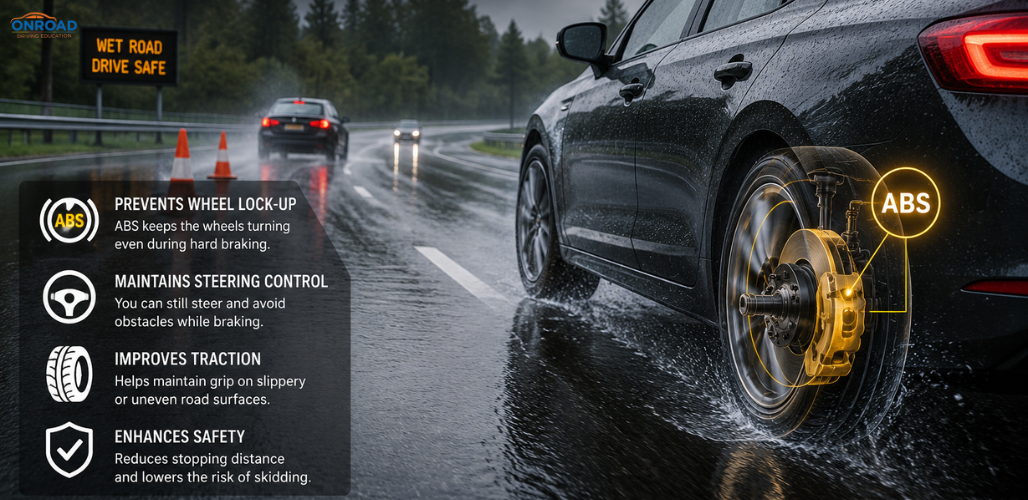
Imagine you are driving down a wet road in Sydney, and suddenly a ball rolls out into the street. You instinctively stomp on the brake pedal. In older cars without modern safety features, your wheels might lock up completely, causing you to skid helplessly into a hazard.
Enter the Antilock Braking System (ABS)—one of the most effective safety features in modern vehicles. But how does it actually work, and how does knowing how to use it make you a safer driver? Let’s break it down.
What is ABS and How Does It Work?
ABS is an automated system designed to prevent your wheels from locking up during sudden or hard braking.
When your vehicle’s wheels lock, they lose traction with the road surface. Without traction, two major problems occur:
-
You lose steering control: You can turn the steering wheel all you want, but the car will keep sliding in the direction of momentum.
-
Your stopping distance increases (especially on wet or slippery roads).
ABS uses speed sensors on each wheel monitored by an electronic control unit. When the system detects that a wheel is about to lock up during heavy braking, it rapidly pulses the brake pressure—releasing and reapplying the brakes up to 15 to 20 times per second.
This ultra-fast pulsing action allows the wheels to keep rotating slightly, maintaining maximum grip on the road while slowing you down as fast as possible.
The Key Safety Benefits of ABS
-
Steering Control in Emergencies: The primary benefit of ABS isn't just stopping faster—it’s allowing you to steer while braking hard. This enables you to steer around an obstacle even when your foot is planted on the brake pedal.
-
Reduced Skidding: By preventing total wheel lock-up, ABS keeps the vehicle stable and prevents dangerous side-ways spins on slick roads.
-
Shorter Stopping Distances on Slippery Surfaces: On wet tarmac or slippery roads typical during a sudden Sydney downpour, ABS helps bring your vehicle to a controlled stop much quicker than conventional braking.
Common Misconceptions About ABS
1. "ABS makes you stop on a dime every time."
While ABS optimizes braking performance, it cannot overcome the laws of physics. If you are tailgating or driving at unsafe speeds, ABS won't magically save you from a collision. Safe following distances are still essential.
2. "The pulsing brake pedal means something is broken."
When ABS kicks in, you will feel a firm pulsating or vibrating sensation through the brake pedal, accompanied by a grinding or clicking noise. Do not take your foot off the pedal! This vibration means the system is working exactly as intended. Keep firm, continuous pressure on the pedal and steer to safety.
Building Real-World Confidence Behind the Wheel
Understanding vehicle technology like ABS is a great start, but hands-on experience is what truly makes a confident driver. Learning how to react calmly during emergency braking situations is a vital skill for every novice driver in New South Wales.
If you're a Learner driver looking to gain practical hazard perception skills and log valuable extra hours, enrolling in a Safer Drivers Course with an accredited driving school is the best step forward.
At a professional Sydney Driving School, taking a tailored driving lesson gives you real-world insights into vehicle safety dynamics—including emergency braking, hazard management, and low-risk driving strategies.
Whether you are looking for a top-tier Driving School Sydney wide or simply preparing to sit your P-plate test, getting professional guidance ensures you know how to handle your car safely in any situation.
Ready to Become a Safer Driver?
Vehicle safety tech like ABS is designed to protect you, but the most critical safety feature in any car will always be the driver.
Book a structured driving lesson or sign up for the Safer Drivers Course with Onroad Driving Education today to build skills and confidence that last a lifetime!