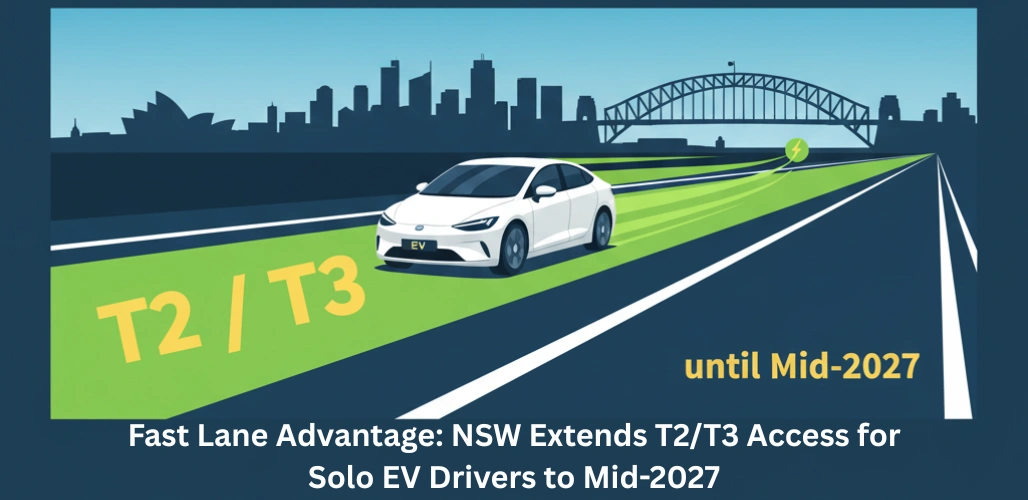
Ever felt frustrated at being stuck in traffic while those in the transit lane go by their work smoothly and efficiently right beside you? To most NSW drivers, the transit lanes often feel like forbidden territory, reserved for buses, taxis, and carpoolers. However, Electric Vehicle owners in NSW have enjoyed access to the transit lane since November 2021, even without meeting passenger requirements. And the NSW government has recently extended the concession date to mid-2027. This is good news for EV owners, as they can continue driving the fast lane solo till the policy lasts (or is further extended!). This extended concession is a genuine game-changer for eco-conscious drivers. And as any instructor at a Sydney Driving School will tell you, smart driving isn’t just about knowing the rules — it’s about making them work for you. So, let’s explore what this concession means for you and how you can save time, stress, and fuel by using this concession to your benefit.

Source Link : https://www.nsw.gov.au/
What Are Transit Lanes and How Do They Work?
Have your driving school instructors told you that transit lanes are fast lanes for driving? The main purpose of introducing Transit lanes was to maintain traffic. They prioritise vehicles carrying more people and thus help segregate traffic and keep the roads flowing. The idea is to move people, not just cars. That’s why:
-
T2 lanes: Require at least two occupants (the driver plus one passenger).
-
T3 lanes: Require at least three occupants.
-
Permanent exemptions: Buses, taxis, motorbikes, and now — eligible zero-emission vehicles.
So, what does that mean for EV drivers? It means you get a free pass to use these priority lanes during peak hours, even when driving alone, but only as long as your car qualifies.
It’s a small shift in policy, but one that can make a big difference during your daily commute. Understanding such rules is one of the many practical lessons you’ll learn during a driving lesson at a professional Driving School Sydney.
Who Can Legally Use a T3 Lane Without Restriction?
In New South Wales (NSW), you can legally drive in a T3 transit lane without restriction if your vehicle meets any of the following criteria:
Vehicles with 3 or more occupants: This includes the driver plus at least two passengers.
Public Transport & Service Vehicles: Buses, coaches, taxis, rideshare vehicles (when carrying passengers), limousines, and motorcycles.
Emergency & Special Vehicles: Ambulances, police vehicles, fire engines, and bicycles.
So, Who Qualifies for the Fast Lane?
If you’re thinking of benefiting from this extension, you might first want to check if you’re eligible. Not every low-emission vehicle is allowed this concession. Only fully Battery Electric Vehicles (BEVs) and Hydrogen Fuel Cell Electric Vehicles (FCEVs) are eligible. So, if you own a hybrid or plug-in hybrid, you don’t qualify for this benefit. It’s reserved for zero-emission vehicles only — part of the state’s broader push to reduce air pollution and encourage sustainable transport.
And if you do own a BEV or FCEV, your car must display the official blue triangular ‘EV’ label on its number plates to enjoy this benefit. No blue label means you’re using the transit lane illegally, and might also get fined for it! So, check your eligibility first and start saving time during the peak hours.
The Real-Time Saver: How Much Faster Is It, Really?
Yes, you can indeed benefit from this concession for EV drivers and save time, but how much? Let’s break it down. Traffic is a pain during Sydney’s peak hours (7:00–9:30 am and 4:00–6:30 pm), and the main lanes move awfully slowly. Meanwhile, transit lanes with minimal traffic can move 5 to 9 minutes faster on average. Doesn’t sound like much of a difference, right? But, here’s what happens if you add it up:
Saving 10 minutes per day (5 minutes each going back and forth) means 50 minutes saved per week. So, basically, you can save over 40 hours per year. That’s an entire work week back in your life! You can save those 40 hours from stressing in traffic and use that time for what really matters — family, hobbies, or maybe even a few extra hours of sleep.
As any good driving school will remind you, efficient driving isn’t just about speed — it’s about planning, awareness, and using every advantage responsibly.
Other Perks: Fewer Jams, Less Stress, More Control
While saving time is great, that’s not all you get out of this concession. This benefit also means fewer traffic jams, less stress for drivers, and better traffic flow. Drivers who can use the T2 or T3 lane legally feel calmer and more in control during their entire day. They know what to expect and are less likely to rush or make risky lane changes. Thus, having a smoother, faster commute can reduce daily stress and fatigue for drivers — both of which are major causes of poor driving performance. Most Sydney driving schools teach drivers to think proactively and understand how small, consistent decisions, like driving smarter or buying the right car, can lead to safer, more confident driving.

Why the NSW Government Extended the Policy to 2027
Originally introduced in November 2021, the solo EV driver concession was designed to encourage drivers to buy zero-emission vehicles. While it was initially going to expire in 2025, the positive results have encouraged the government to extend it until 30 June 2027, giving EV owners nearly two more years of benefit. The main purpose behind this is to increase EV users and ultimately reduce carbon emissions and air pollution, creating cleaner, quieter cities.
So, whether you’re a current EV owner or considering one, this is an incentive worth noting, especially if you drive in Sydney’s peak-hour zones.
The Road Ahead: Why This Policy Matters for You
This policy of granting transit lane access to Solo EV drivers is more than offering convenience. It’s a way of changing the flow of traffic, especially in cities. It is also an encouragement to move towards cleaner and safer transport options while reducing traffic congestion for all road users. So, if you’re an eligible EV owner, make sure you’ve got your blue ‘EV’ label displayed proudly. And if you’re a novice still working toward your licence, joining a reputable Sydney Driving School like Onroad Driving School can help you understand the road rules better and build the skills and awareness that every responsible driver needs. Because the future of commuting in Sydney isn’t just electric — it’s smarter, faster, and happening right now in the fast lane.
Frequently Asked Questions
Q1. Who can use the T2 and T3 lanes in NSW under the new EV rule?
A: Solo drivers of Battery Electric Vehicles (BEVs) and Hydrogen Fuel Cell Electric Vehicles (FCEVs) can legally use T2 and T3 lanes in New South Wales. However, the vehicle must display the official blue triangular ‘EV’ label on its number plates to qualify. Hybrids and plug-in hybrids are not eligible under this rule.
Q2. How long does this EV lane exemption last?
A: The NSW Government has extended the solo EV access to T2 and T3 lanes until 30 June 2027. This extension gives electric vehicle owners more time to enjoy faster, less stressful commutes while supporting the transition to zero-emission transport.
Q3. What happens if I don’t attach the EV label or use the transit lane without qualifying?
A: If your vehicle isn’t eligible or you’re missing the ‘EV’ label, you could face fines and demerit points for misuse of a transit lane. Before using these lanes, ensure your registration and label are up to date.
Q4. How much time can solo EV drivers actually save using transit lanes?
A: During Sydney’s peak hours, EV drivers using T2 or T3 lanes can save up to 5–9 minutes, adding up to nearly 40 hours a year — the equivalent of a full work week! That’s a major perk for daily commuters, especially in high-traffic areas.
Q5. How does this policy tie into safer and smarter driving habits?
A: The EV transit lane exemption encourages drivers to adopt eco-friendly and efficient driving practices. It aligns with what professional driving schools promote — being aware, planning, and driving responsibly. It’s not just about reaching faster; it’s about driving smarter.