What This Article Covers
Australia's busiest crash hotspots reveal important lessons about following distance, observation, lane changes, intersections, and staying calm when traffic becomes unpredictable.
What Crash Hotspots Can Teach Learner Drivers
You might find it tiring to hear your Sydney driving school instructor go on about dangers on the road and how safety is important. But have you ever wondered what makes a road dangerous? You might think it’s high speeds, uneven roads, sharp bends, or poor visibility. Or perhaps it’s heavy traffic, frequent intersections, or multiple lanes. But some of Australia's biggest crash hotspots don’t look very dangerous at first glance. They're busy arterial roads filled with traffic lights, shopping centres, turning lanes, and vehicles constantly moving around one another. So, the challenge they present isn’t necessarily speed or terrain. It's the number of decisions you need to make in a short space of time.
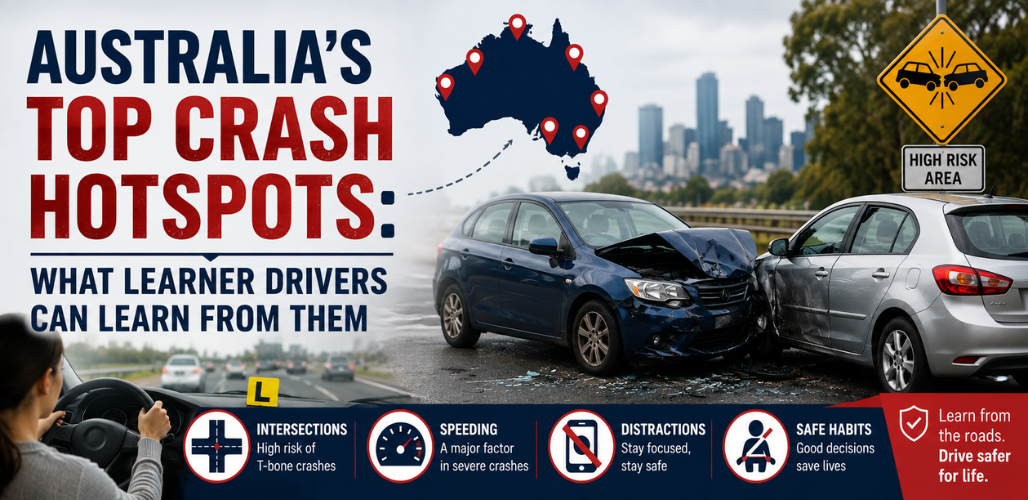
The latest AAMI Crash Index 2026 found that nine of Australia's top 10 crash hotspots are in Melbourne, with Pennant Hills Road in Carlingford the only Sydney road to make the national top 10. Springvale Road in Glen Waverley took the number one spot, followed by Plenty Road in Bundoora. So, for a learner driver, the useful driving lesson here isn't memorising which roads made the list. It's understanding what these roads have in common and how the same risks can appear anywhere.
What Australia's Crash Hotspots Have in Common
The roads at the top of the AAMI list share several characteristics: heavy traffic, multiple lanes, traffic lights, major intersections, shopping precincts, and frequent turning movements. But that’s not all. AAMI also found that the main reasons for these crashes were everyday driving behaviours. These included following too closely, braking late, misjudging turns, and failing to anticipate changing traffic conditions. But how does knowing the reason help? It matters because these aren't unusual conditions. You can encounter these situations on an ordinary trip across Sydney. So, if you want to ensure safety, you should learn to recognise the risk before it becomes an emergency. This is where a professional driving program or a Safer Drivers Course can help.
Four Risk Moments Learner Drivers Need to Watch For
1. When Traffic Suddenly Slows
In NSW, drivers should maintain at least a three-second following distance in good conditions and increase it to four or more seconds in poor conditions. If the driver ahead of you brakes suddenly, you also need to react to your sudden stop accordingly, and before long everyone is braking harder than necessary. But if you leave a safe following distance, you get enough time to respond without having to brake suddenly. Don't judge your following distance by how close feels comfortable. Give yourself room to react.
2. When Your Lane Is About to Change
When you’re driving down a busy arterial road, you might find merging and turning lanes, lane arrows, and changing traffic conditions distracting. You might need to make quick judgments and decisions. Don’t wait until the last moment to decide where you need to go. Look further ahead on the road for signs, road markings, and traffic flow. If you need to change lanes, plan early, check that it's safe, and avoid making a rushed move simply because you realise you're in the wrong lane. Missing a turn is better than risking the consequences of an unsafe lane change in heavy traffic.
3. When Several Hazards Appear at Once
You might think you can finally relax a bit when the light turns green. However, getting distracted or losing attention while driving, even when the traffic light is green, can be very risky. You might have pedestrians nearby, a vehicle turning across your path, cars entering from a side street, or a bus pulling away from the kerb. You should learn to constantly scan and observe your surroundings rather than focusing on just one thing. This is especially important at large intersections, where several movements can happen simultaneously. So, when the road becomes busy, don't try to process everything at once. Look further ahead, reduce your speed if necessary, maintain space, and deal with each developing situation in turn.
4. When You're Tempted to Check Your Phone
You’re waiting for the traffic light to turn green when you hear that tell-tale ping, and you think, what’s the harm in checking a notification while you’re stuck, right? Heavy traffic can feel like the perfect time to glance at a notification, particularly when you've stopped at lights. However, NSW learners and provisional drivers cannot use a mobile phone while driving, including when stopped at traffic lights or stuck in traffic. It’s better to put your phone away before you start driving. You shouldn't need to make a decision about it when you're already dealing with a complicated road environment.
The Best Way to Approach a High-Traffic Road
Perhaps the biggest lesson you can take away from Australia’s crash hotspots is that safe driving isn't about reacting perfectly when something goes wrong. It’s about ensuring you have ample time and space to react. It can help you avoid making a desperate decision in the first place. So, what you should remember to do is look ahead, leave enough space, plan your lane changes early, and stay patient at intersections. And when you think the traffic has become unpredictable, slow down rather than rush to keep up. These habits are just as valuable and necessary on the suburban street around the corner as they are on Pennant Hills Road.
Build Confidence on Busy Roads
Learners often become more confident by practising the roads and situations that initially make them uncomfortable. A good driving lesson isn't just about learning how to steer, brake, or change gears. It's an opportunity to develop the observation, space management, lane positioning, and decision-making skills that help you manage real traffic. Whether you're preparing for your driving test or looking to become a safer driver beyond your Ls, the right guidance can make a real difference. For NSW learners who want to develop their hazard awareness and decision-making skills further, the Safer Drivers Course or any other driving education program at a Sydney Driving School can help build a stronger understanding of the road risks involved.
At Onroad Driving School, we have many experienced instructors who can help you build these habits across a range of road conditions and traffic situations. Book a driving lesson today and see how we can help you become a better, safer, and more responsible driver.
Frequently Asked Questions
Q1. What is the most crash-prone road in Australia?
A: According to the 2026 AAMI Crash Index, Springvale Road in Glen Waverley, Victoria, was Australia's number one crash hotspot. Pennant Hills Road in Carlingford was the only Sydney road in the national top 10.
Q2. Why do busy roads have more crashes?
A: Busy arterial roads often combine heavy traffic, multiple lanes, traffic lights, intersections, turning movements, and shopping precincts. This creates more opportunities for following, braking, lane-changing, and observation errors.
Q3. How much following distance should I leave in NSW?
A: In good conditions, NSW guidance recommends at least a three-second crash avoidance space. Increase this to four or more seconds in poor conditions, such as wet roads or at night.
Q4. What should learner drivers do when traffic becomes unpredictable?
A: Slow down if necessary, increase your space from other vehicles, keep scanning ahead, and avoid rushed manoeuvres. Giving yourself more time to respond is often safer than trying to maintain the same pace.